Telegram is bringing a non-custodial Gram wallet to its 1B+ users this summer. Here's how it may work, and what it might mean for TON adoption.

Crypto apps have to fight for every user who’s willing to go through the steps. You have to download a wallet, write down a seed phrase, and learn what a transaction does before you get to touch anything.
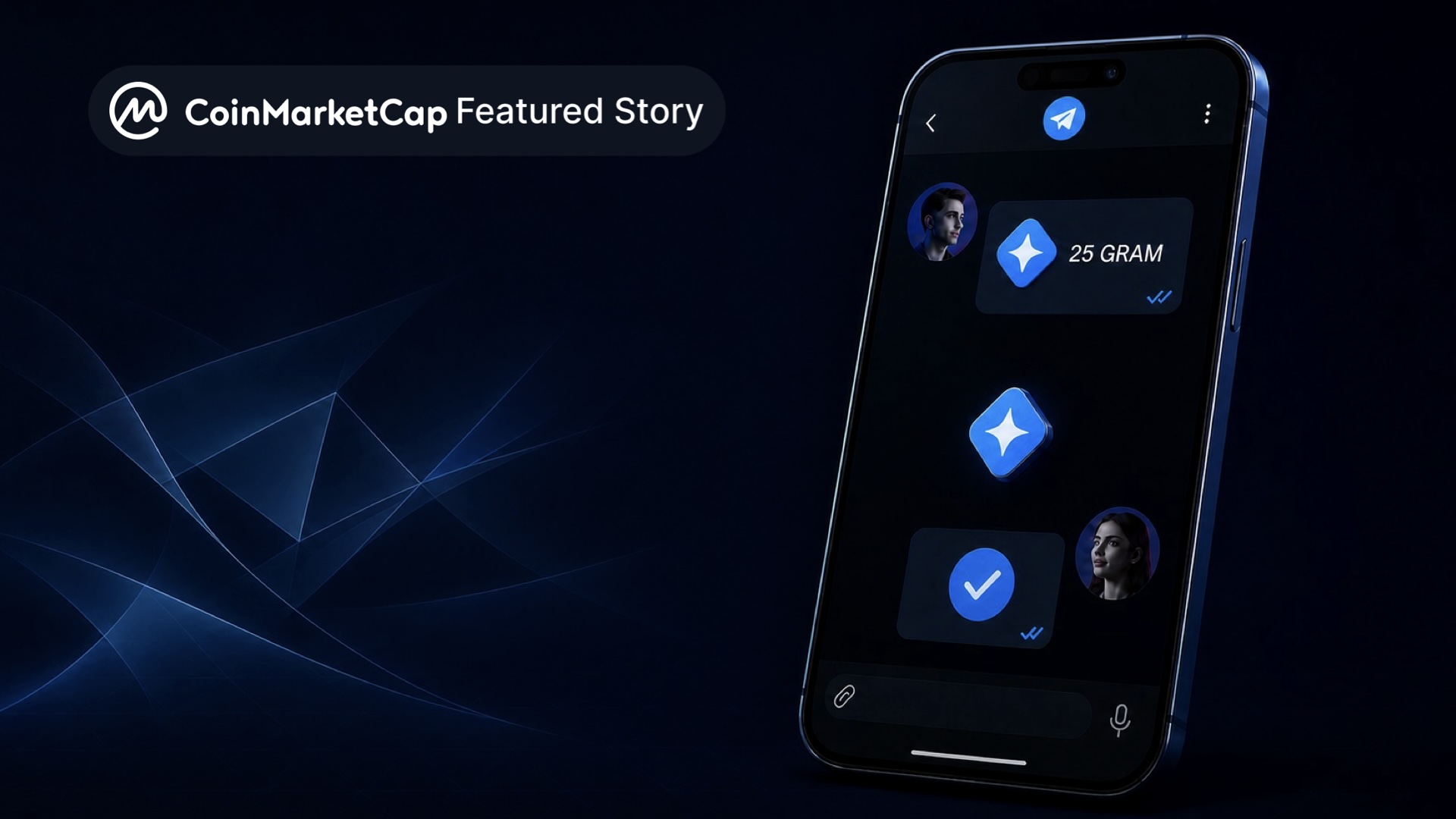
Telegram said it's skipping that fight. On July 21,Pavel Durov announced Telegram will build a native, non-custodial Gram (GRAM) Wallet—named after The Open Network's (TON’s) token recently rebranded from Toncoin—into every Telegram app this summer, targeting its more than 1 billion users with instant, zero-fee transactions. Durov called it “the largest rollout of a non-custodial crypto wallet in human history.”
Source:
This isn't Telegram's first attempt. It already runs an in-app wallet, the @wallet bot, with more than 150 million registered users, though that one is partly custodial by default.
Gram Wallet is built to be non-custodial from the start, which means only the user holds the private keys. Telegram can't access them, reverse a transaction, or restore a lost account.
This is a bigger, less custodial wallet landing on a massive user base already battered by scams. The real question is whether it becomes real usage, a short-lived token story, or a bigger target for scammers.
Telegram Cuts Seed Phrases and Separate Downloads
Non-custodial wallets are harder to use than custodial ones. Lose your key, and there's no company to call, no funds to recover.
Telegram’s answer to that risk is swapping the seed phrase for something people have already memorized.In July 2025, the platform rolled out a self-custodial TON wallet to 87 million US users, using a split-key recovery model instead of the usual 12- to 24-word phrase, with one key tied to the Telegram account and the other to an email address.
That split-key model runs on TON, Telegram's blockchain infrastructure. TON's token was renamed from Toncoin (TON) to Gram (GRAM) in June 2026, with existing balances automatically carrying over.
Cutting the seed phrase lowers the barrier for first-time users, but it relocates the risk rather than removing it. Recovery now depends on your Telegram account and email inbox, since whoever controls those controls the wallet.
Durov's July 2026 announcement left that framework unresolved. It’s not clear whether Gram Wallet will keep this split-key model, what will happen to the existing @wallet bot, or how the promised zero-fee transactions will get funded.
Whatever Gram ships, that exposure doesn't go away. A SIM swap, a hacked email, or a recycled phone number can hand a stranger control of a non-custodial wallet, and unlike a bank or exchange, no support line can undo it.
TON, the Token vs. TON, the Blockchain
When Telegram rolled out that 2025 TON Wallet to 87 million US users,TON's price rose about 3% within 24 hours, part of a rally that had already carried the token up 12.2% over the prior week and 25.6% over the prior month, before any of those users had even opened the wallet.
What happened to on-chain usage after the headlines faded is interesting. More than a year after that 87-million-user rollout, TON chain total value locked (TVL) currently sits at roughly $60 million, flat over the past several days and down about 90% from its 2024 peak of nearly $800 million.
TON’s TVL chart. Source: DefiLlama
That gap won't close through a price chart alone. Telegram has taken over as TON's primary ecosystem steward and largest validator, replacing the independent TON Foundation, so the same company now controls both the network's infrastructure and its usage reporting, with no outside foundation checking the numbers.
Security Risks of a Messaging App-Based Wallet
A wallet built into the app you already use may sound safer, since you never move funds to a separate app to spend them, but there are also security concerns to consider with thinking about a wallet built into Telegram.
At least eight major Chinese-language Crime-as-a-Service groups, some with more than 300,000 members, operate on Telegram, selling phishing kits built to harvest private keys and session tokens.
And beyond phishing links asking for your seed phrase, stealer malware and remote-access Trojans add a growing risk. Wallets are increasingly drained with a single click, without any credentials handed over.
Concentrating everything in one app concentrates the failure point. That click may now directly reach a live, spendable balance.
Whether that click can be undone depends on who can still stop the transaction afterward.
A custodial wallet lets Telegram freeze a transaction or slow a withdrawal with limits and manual review, but Gram, by design, has no such backstop. Once a key is stolen, the transfer is instant and irreversible.
That finality creates a comprehension risk of its own. A user who doesn't understand what non-custodial means might expect Telegram to reverse a fraudulent transfer it can’t.
That expectation gap also shows up in regulation.Telegram's existing wallet restricts service in the US and several other jurisdictions, but that restriction operates at the app level and doesn't directly touch the wallet's keys.
Whether it can stop a non-custodial wallet the same way, or can only block the interface while funds remain reachable elsewhere, isn't clear yet.
The Zero-Fee Promise Hasn’t Been Explained
Durov's zero-fee promise has no disclosed mechanism as of yet. His announcement last month didn't clarify how those fees get subsidized, or when the feature ships.
What has shipped is the speed layer underneath it. TON's Catchain 2.0 upgrade, which changed how validators confirm transactions, went live in April 2026, delivering a 6x increase in block rate and cutting transaction finality to under a second, down from roughly 10 seconds.
Telegram isn't the only company making this wager. Coinbase has been building the same idea from the developer side: a self-custodial wallet embedded in other companies' apps rather than a standalone download.
Coinbase's version reaches users only through apps that choose to integrate it, while Telegram's would switch on by default for its own billion-plus accounts.
Gram Wallet and Coinbase are testing the same idea from opposite starting points. If frictionless in-chat transacting fails to produce real usage across both attempts, that's a stronger signal than either company underperforming alone.
A huge announcement reaching a billion existing users only shows how many people saw the idea. Whether they use it is the part that takes months to answer.
TON chain TVL climbing off its roughly $60 million floor, independent of any price move, is what real adoption would look like, along with clarity on how split-key recovery and the fee subsidy work once the wallet ships.
GRAM currently trades near $1.40, with a market cap of about $3.83 billion. Price and attention could rise again without usage following, repeating the 2025 pattern.
Source: Vortex
The real test is whether removing the download-and-seed-phrase step by default produces more usage than the industry's one-download-at-a-time approach.
This article contains links to third-party websites or other content for information purposes only (“Third-Party Sites”). The Third-Party Sites are not under the control of Vortex, and Vortex is not responsible for the content of any Third-Party Site, including without limitation any link contained in a Third-Party Site, or any changes or updates to a Third-Party Site. Vortex is providing these links to you only as a convenience, and the inclusion of any link does not imply endorsement, approval or recommendation by Vortex of the site or any association with its operators. This article is intended to be used and must be used for informational purposes only. It is important to do your own research and analysis before making any material decisions related to any of the products or services described. This article is not intended as, and shall not be construed as, financial advice. The views and opinions expressed in this article are the author’s [company’s] own and do not necessarily reflect those of Vortex.

